

Blasphemy! Sure. I am a blasphemer, if you believe in such things.
Besides blaspheming, I work as a carpenter. I had an epiphany about Jesus during my carpentry apprenticeship, and have finally decided to share it. My insight is that Jesus became a great spiritual teacher once he put down his tool belt. Allow me to explain.
I came to carpentry late in life, thanks to the pandemic. I left NYC in 2019 to lick my wounds after being “let go” from the job I had moved there for, and then let go again by my fiance. I landed in Colorado, heart full of sadness, just in time for Covid.
Blessed are they who mourn, for they will be comforted. ~Matthew 5:4
Prior to the plague I made a living teaching yoga and photographing people. Those in-person occupations were disrupted by lockdown. As a man of many pivots, I went to work in the UPS warehouse and soon was driving the brown truck, exploring the winding roads and gated communities around me.
I found the slowing down of normal life to be comforting. In my free time I sat by an irrigation creek behind my apartment playing my guitar and singing to the animals that gathered to listen. None of us wore masks, and it was good.
Blessed are the pure in heart, for they will see God. ~Matthew 5:8
A friend of mine in Massachusetts (let’s call him Matthew) called me up one day looking for the phone number of another friend. His carpentry business was blowing up because everyone was stuck home looking at their walls, yearning to tear them down. Fortunately, or not, the other friend wasn’t available.
After some consideration I said to Matthew, “Lo if you shall put your faith in me, I will help you build.”
A couple months later I landed in the land of the Puritans. Matthew gave me a tool belt and a screw gun and began patiently teaching me the ways of the carpenter. As the weeks passed and his patience began to wane, each board that I cut too short was added to the cross I bore.
To repent, I gave myself daily mental floggings while repeating the mantra, “Measure twice, cut once. Measure twice, cut once. Measure twice, cut once.”
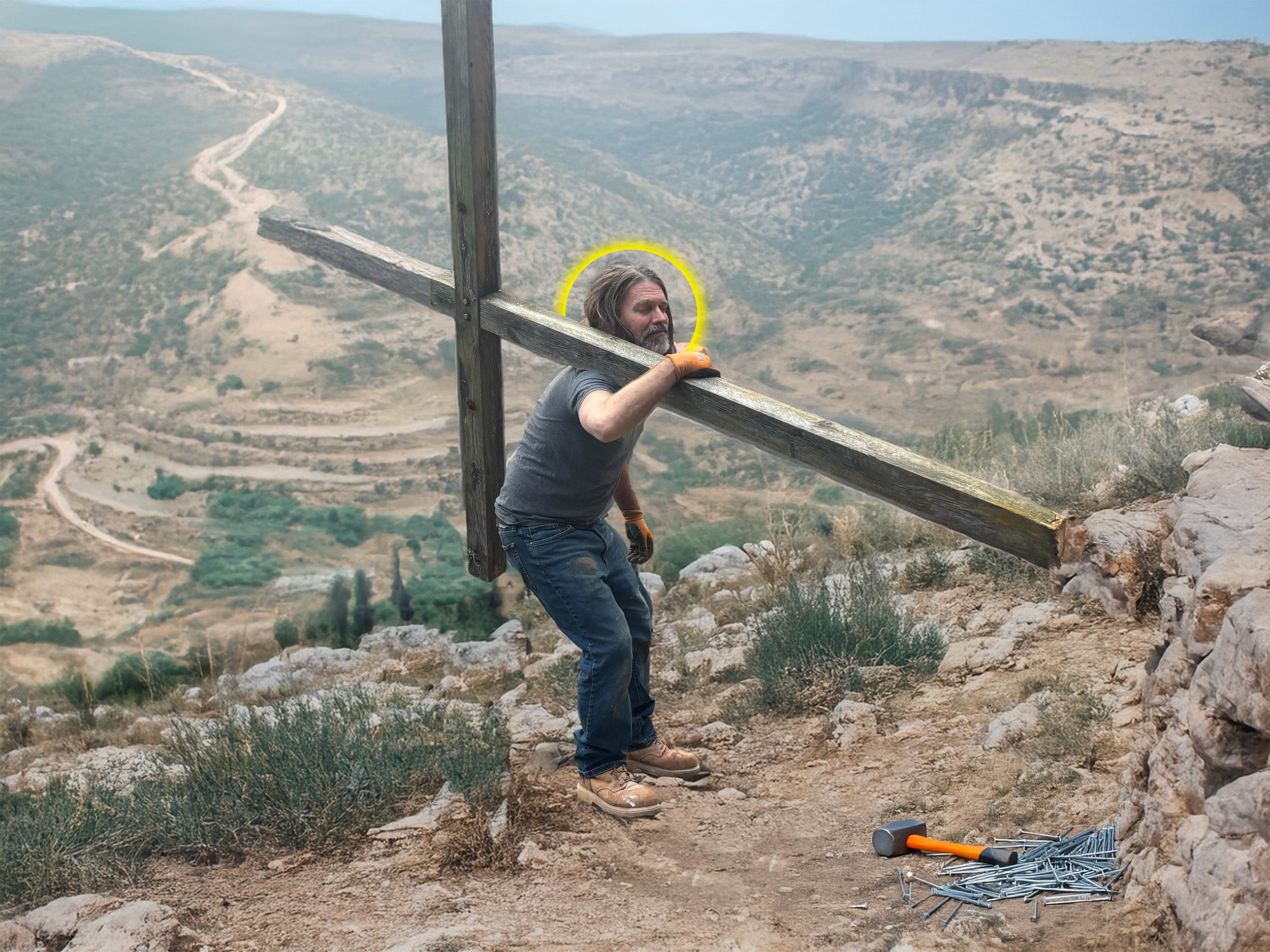
One day, after repeating the measurement mantra 108 times, I received a vision. I was in ancient Rome and there were three Pharisees hanging out on a newly assembled wooden bench. Suddenly, there was a creaking sound, and the whole thing collapsed. They fell to the ground, startled. One of them cried out, “Jesus Christ!”
A bearded young man with long hair and a toolbelt appeared, a look of embarrassment on his face.
“What in Abraham’s name happened?” the eldest Pharisee grumbled, indignantly.
“I skimped on the nails,” Jesus muttered.
Son of a Carpenter
For want of a nail, the bench was lost. For want of a bench, the dignity of the Pharisees was lost. For want of dignity, the respect for Jesus was lost. For want of respect, Jesus quit being a carpenter. For lack of a carpentry skills, Jesus began his search for meaning. For want of meaning, Jesus found deeper truths and started a religion. And all for the want of a nail.
As I pondered the meaning of my vision, I began to realize that there wasn’t a record of anything Jesus built. Christians will say he built the church, but that is a metaphor that turns out not to be true.
If Jesus were truly god in human form, wouldn’t he have built something spectacular? Something that would still be standing, or at least referenced in the Christian bible?
The direct biblical references to Jesus being a carpenter are actually quite limited.
Mark 6:3 is the primary verse where Jesus is directly called a carpenter. When Jesus teaches in his hometown synagogue, people respond: “Is not this the carpenter, the son of Mary and brother of James and Joses and Judas and Simon? And are not his sisters here with us?”
This is the only place in the Bible where Jesus himself is explicitly identified as a carpenter.
Matthew 13:55 gives a parallel account of the same incident, but with slightly different wording: “Is not this the carpenter’s son? Is not his mother called Mary? And are not his brothers James and Joseph and Simon and Judas?”
Here Jesus is called the carpenter’s son rather than a carpenter himself, referring to Joseph’s occupation. Whether by Yahweh or by Joseph, was not Jesus, after all, the ultimate nepo baby?
Interestingly, the original Greek word used is “tekton” (τέκτων), which is often translated as “carpenter” but could more broadly mean a craftsman or builder who worked with wood, stone, or other materials. It’s all Greek to me.
Parables
Jesus loved speaking in parables. His parables tend to draw from other aspects of daily life in first-century Palestine: agriculture, fishing, shepherding, household management, business and finance. Jesus offers only two parables from a builder’s perspective.
“Therefore everyone who hears these words of mine and puts them into practice is like a wise man who built his house on the rock. The rain came down, the streams rose, and the winds blew and beat against that house; yet it did not fall, because it had its foundation on the rock. But everyone who hears these words of mine and does not put them into practice is like a foolish man who built his house on sand. The rain came down, the streams rose, and the winds blew and beat against that house, and it fell with a great crash.” Matthew 7:24-27
Perhaps Jesus was speaking from experience. Was he still feeling shame over that house he built in the sand? Jesus revealed another embarrassing moment from his time as a contractor later in the New Testament.
“For which one of you, when he wants to build a tower, does not first sit down and calculate the cost, to see if he has enough to complete it? Otherwise, when he has laid a foundation and is not able to finish, all who are watching it will begin to ridicule him, saying, ‘This person began to build, and was not able to finish!’ Luke 14:28-30
Jesus’ miscalculations lost him a few contracts. Life happens. His peers besmirched his name, for carpentry was a cut throat industry even then. Fortunately, the fortitude Jesus gained from these experiences would help him out later.
After Jesus laid the foundation for a tower and ran out of funds, he went for a long walk. As he shuffled his way along the Jordan River he encountered John the Baptist, and decided he could use a bath. Carpentry is a dirty job.
John dunked him in the water and washed away the masonry dust. It was then that Jesus realized he wasn’t meant to be a tradesman. He decided to spend forty days in the wilderness to figure shit out. The rest is His story.
Turning the other cheek
Growing up in the United States in this era, I can make jokes about Jesus, and probably won’t be crucified for them. There have been plenty of other times and places where my words would be considered heresy and I would be tortured and killed.
(As you may have noticed, fascism is making a comeback here in the USA. I may be crucified soon enough.)
There is an irony in Christianity. It is a religion built around the life and words of a compassionate and forgiving teacher, and yet the religion itself has been the cause of untold oppression, bigotry, hatred and war.
Jesus laid the foundation for the tower that would become Christianity, and then he ran out of time. The Romans came to collect, built him a cross, and without irony, nailed him to it.
If Jesus had built his own cross, it would have fallen over and the story would be different. Alas, the Romans were skilled carpenters.
Better (not) call Saul
Misogynists and slave owners find their saviour
The tower of Christianity was listed on Desert Zillow for many years before a Roman citizen named Paul came along to buy it. Paul was a devout Jew in the Pharisee tradition, known as Saul, and he got off on persecuting the Christian sects that had formed after the crucifixion.
One day, on his way to Damascus, he allegedly had his own vision. He saw Jesus, who asked, “Saul, why are you persecuting me?"
And lo, after his self-reported seizure in the desert, Paul decided to completely reinvent Jesus. The other apostles said ‘wait, that’s not what Jesus meant,’ but Paul had a vision. Was it divinely inspired? Based on his actions, it is highly unlikely.
Saul/Paul “converted” to Christianity and became its biggest proponent, but he lacked the compassion and wisdom that Jesus embodied.
Unfortunately for us, he was better at spreading his distorted version of Christianity than other early Christians. Here are some reasons why:
His Roman citizenship allowed him to travel freely and eventually appeal to Caesar
His Pharisaic training gave him deep knowledge of scripture and theological argumentation
His persecution of Christians gave him credibility in regards to the reality of his conversion
His status as an outsider to Jesus’ original disciples created some tensions but also gave him freedom to interpret the gospel for Gentile audiences
Interpretation is where the trouble starts, and continues into this present moment. Jesus was a masterful teacher, and if modern Christians were just to live their lives by his teachings then the world could be a more peaceful and compassionate place. Instead, they live in the tower of Christianity whose foundation was laid by Jesus, but from the ground up completed by the bigoted and sadistic Saul/Paul.
Blessed are the Misogynists, for they shall inherit the oval office.
According to Paul, in his letter to the Corinthians:
The women should keep silent in the churches. For they are not permitted to speak, but should be in submission, as the Law also says. If there is anything they desire to learn, let them ask their husbands at home. For it is shameful for a woman to speak in church. ~1 Corinthians 14:34-35
Got Patriarchy? Jesus spent three years breaking down gender barriers. Paul spent three epistles rebuilding them.
Jesus was a Jewish prophet focused on social justice, caring for the poor, and critiquing religious hypocrisy. He never claimed to be founding a new religion or dying for humanity's sins. That’s all Paul’s improvised story.
Paul never met Jesus. His conversion was likely either psychosis or a megalomaniacal plan to gain stature. He claimed divine revelation, creating doctrines that served his own vision. He had conflicts with Jesus' actual disciples (like the Jerusalem church led by Jesus’ half-brother James) who saw him as distorting the message.
Saul was a role model for president Trump.
Blessed are the slave holders, for they shall inherit the Republican party.
He also loved slavery.
Slaves, obey your earthly masters with respect and fear, and with sincerity of heart, just as you would obey Christ. Obey them not only to win their favor when their eye is on you, but as slaves of Christ, doing the will of God from your heart. Serve wholeheartedly, as if you were serving the Lord, not people, because you know that the Lord will reward each one for whatever good they do, whether they are slave or free. ~Ephesians 6:5-8
To be fair, slavery was common in those times. It’s hasn’t really gone away in ours; it just shifted form. Nonetheless, a holy man would know it is evil. A god in human form would certainly speak out against it. A false prophet like Paul would find ways to justify it.
Paul was a Biggus Dickus.
Similar to the way that our president is making America great again by destroying all the pillars of democracy set forth in our Constitution, Paul's letters (thirteen epistles that became books in the New Testament) are notable in their failure to mention the ministry, teachings, and miracles of Jesus. He never quotes the Sermon on the Mount, never mentions Jesus' parables, healing miracles, or interactions with people.
There is a meme in Christianity you have probably heard, “What would Jesus do?” If you asked Paul, he would make something up. Jesus led by example and told us to feed the poor and visit the sick. Paul changed it up, saying all we really need is faith.
It all revolves around Paul’s alleged visions of Jesus long after Jesus was dead. There is no fact checking, just a leap of faith based on the ravings of a lunatic.
“Let every person be subject to the governing authorities, for there is no authority except from God, and those authorities that exist have been instituted by God. Therefore whoever resists authority resists what God has appointed, and those who resist will incur judgment.” ~Romans 13
Paul wrote in Romans 13 that all authority comes from God and people should submit to governing authorities. Jesus was literally executed by the government for challenging authority. Ironically, Paul ended up getting murdered by the Roman government as well.
Jesus rejected worldly power. Paul fetishized it. Constantine militarized it.
The Ship of Theseus, also known as Theseus’s Paradox, is a paradox and common thought experiment about whether a ship is the same object after having all of its original components replaced with others over time.
Christianity is like that, there is not much let untouched. Every age and empire has had its way with it.
It’s probable that some of the letters attributed to Paul were written by someone else. The words of Jesus have been remembered in a telephone game, then written, then translated, and then used by each new sect and government to say what they need him to say. Religion is the opiate of the masses, and the crowbar of the elites.
When in Rome…
Centuries after murdering Jesus and Paul, the Roman empire went on to embrace Christianity. At least their own version of it. Constantine legalized Christianity it in 313, and Theodosius made it the state religion in 380.
Pagan holidays were mingled with Christian beliefs; Easter and Christmas, both originally set apart for worship of pagan deities, were assimilated and rebranded to reflect Christian themes.
Wars of the Empire became holy wars; church leaders looked for civil sanctions to back up ecclesiastical judgments; rulers began to convene synods and intimidate their proceedings; the church learned to invoke state coercion against heretics.
After legalizing Christianity, Constantine remained Pontifex Maximus, keeping his title as high priest of the pagan Roman religion throughout his reign, never fully abandoning pagan practices. He waited until his deathbed to be baptized, a practice that became common - people would delay baptism so they could commit “necessary” sins as rulers, then wipe the slate clean before death.
This pattern of Christian “seeking the loophole” behavior wouldn’t change much throughout the ages.
Medieval Manifestations
Over time, empires came and went. The church grew stronger. By the medieval times the Catholic church was selling indulgences, preaching purgatory, punishing people for translating the bible into languages that common people could understand, and creating massive wealth for clergy.
In the 1500’s the Reformation set out to fix some of the most obvious problems. Martin Luther translated the Bible into German, and then others follow, translating it into common languages. This led to the many sects of Christianity we know today, each believing that they have the right interpretation of Jesus. Lutherans, Calvinists, Anglicans, Anabaptists, Baptists, Methodists, Pentecostals, etc;
Forgive them father, they know not what they do.
Christianity today is not what Jesus set out to create. He was not a skilled builder.
Today it is astonishing how easily people are falling in line with the MAGA movement and Trumpism. Even saying our president is divine, and that the wars he fights are holy ones.
A combat-unit commander told non-commissioned officers at a briefing Monday that the Iran war is part of God’s plan and that President Donald Trump was “anointed by Jesus to light the signal fire in Iran to cause Armageddon and mark his return to Earth” ~Military.com
If the actual Jesus was here to see it, he would no doubt be horrified.
The teachings of Jesus were clear and simple. Love your neighbor, do unto others as you would have them do unto you, turn the other cheek. The kingdom of god is here and now, within us. Practice peace, humility, and service. Love god.
Paul created “wishful thinking” Christianity, where we could be forgiven for our sins by accepting Jesus into our hearts. We could hate and persecute others, especially women, slaves, Jews, and anyone not like us. Paul’s Christianity is a war between God and Satan for control of the world.
Over the centuries, sculpted by empires and corrupt clergy, the teachings were weaponized. Racism, bigotry, and misogyny find shelter within the fundamentalist churches. Politicians hide behind scriptural nonsense that has nothing to do with what Jesus taught. They reference the Bible and the Constitution constantly, without understanding the spirit of either one.
And so it is now, as throughout human history, that those in power use religion as an opiate for the masses, to control and divide us.
In the United States, religion and partisan politics have become increasingly intertwined. The rising level of religious disaffiliation is a backlash to the religious right: many Americans are abandoning religion because they see it as an extension of politics with which they disagree. Politics is also shaping many Americans’ religious views. There has been a stunning change in the percentage of religious believers who, prior to Donald Trump’s presidential candidacy, overwhelmingly objected to immoral private behavior by politicians but now dismiss it as irrelevant to their ability to act ethically in their public role. The politicization of religion not only contributes to greater political polarization, it diminishes the ability of religious leaders to speak prophetically on important public issues. ~The Perils of Politicized Religion by David Campbell
Catch 22
I have come to believe there is a proclivity among “the faithful” to accept the interpretations of Jesus put forth by the churches. The narratives are compelling, the black and white simplicity of good versus evil gamifies our time here on Earth. Surrounded by other believers, it is easy to believe. We are social and tribal creatures.
There is also the clever catch-22 in Christianity, that to question your faith is to surrender to Satan. It keeps believers from pulling too many strings. For centuries, the barrier of understanding the Latin language kept the masses in check. But is it any different now? The state and mega churches interpret the bible, pick out the lines that keep us at odds with one another, and preach it to the masses.
What if the Christian’s are right?
"It's better to believe in God and be wrong than not believe and be wrong" ~Pascal’s Wager
Perhaps Pascal was not a skilled gambler, he only had the generic Christianity card in his hand. The deck of religions is 4,200 deep. There are as many ways to believe, love, and honor god as there are people. Even plants bow towards the sun. What monster of a god would fill the world with such confusion that we have to be born in a specific time and place to even have a chance at escaping eternal damnation?
One that loves to hear his own name, have it placed on buildings and billboards, tacky knick knacks, and in the mouths of bigots as they commit atrocities in his name? Sounds like our president. There is a connection there, for sure. Believe in one lie, and it is a short step to worshiping another.
Forgiving Jesus
As a humble carpenter, I forgive Jesus. He wasn’t the son of god, just a child of god like the rest of us. He did his best to bring a little kindness into the world.
If some of what he said in the first four Gospels of the New Testament truly came from his mouth, he truly was a great teacher.
In carpentry, there is a set of skills passed down through generations. The materials change, the structures evolve, and skilled carpenters bring pride and attention to detail to the job. There are maths and geometries that stay consistent.
What if loving god and living a spiritual life was like that? We have so many wisdom traditions to draw upon. We have the scientific method to add to them. So much of the trouble in the world comes from believing we are right, and that truth is black and white.
We need more space for uncertainty. We need more space for diversity. Trees and flowers rely on the sun for life, but they have many different ways of showing up in the world. If they all appeared and behaved the same way, our lives would lose multitudes of beauty.
People are like that, too. Most of us agree that god and love are closely related. Instead of asking, “What would Jesus do?”, perhaps we should ask the question, ‘What would Love do?”
Love would not lead us into wars, or deny brown people freedom and justice. Love would not hoard money or land. It would not dump toxins into our sacred waters. Love would not talk endlessly about itself, or post angry comments on social media.
Love would forgive Jesus for not creating a perfect religion. Love would still love Jesus. I certainly don’t want anyone to give up their love of Jesus. I only pray for us to all widen our circles of compassion.
Love would forgive Saul, too. I’m not sure I can go that far, but I am working on it.
Happy Easter.
Derek, this is brilliant, hilarious and deeply spiritual. You could easily get this published somewhere. You have a huge talent with language. It’s a really enjoyed to read your words. So many great sentences. Just one, ‘Religion is the opiate of the masses, and the crowbar of the elites.’ your creative talent, never ceases to amaze me.