

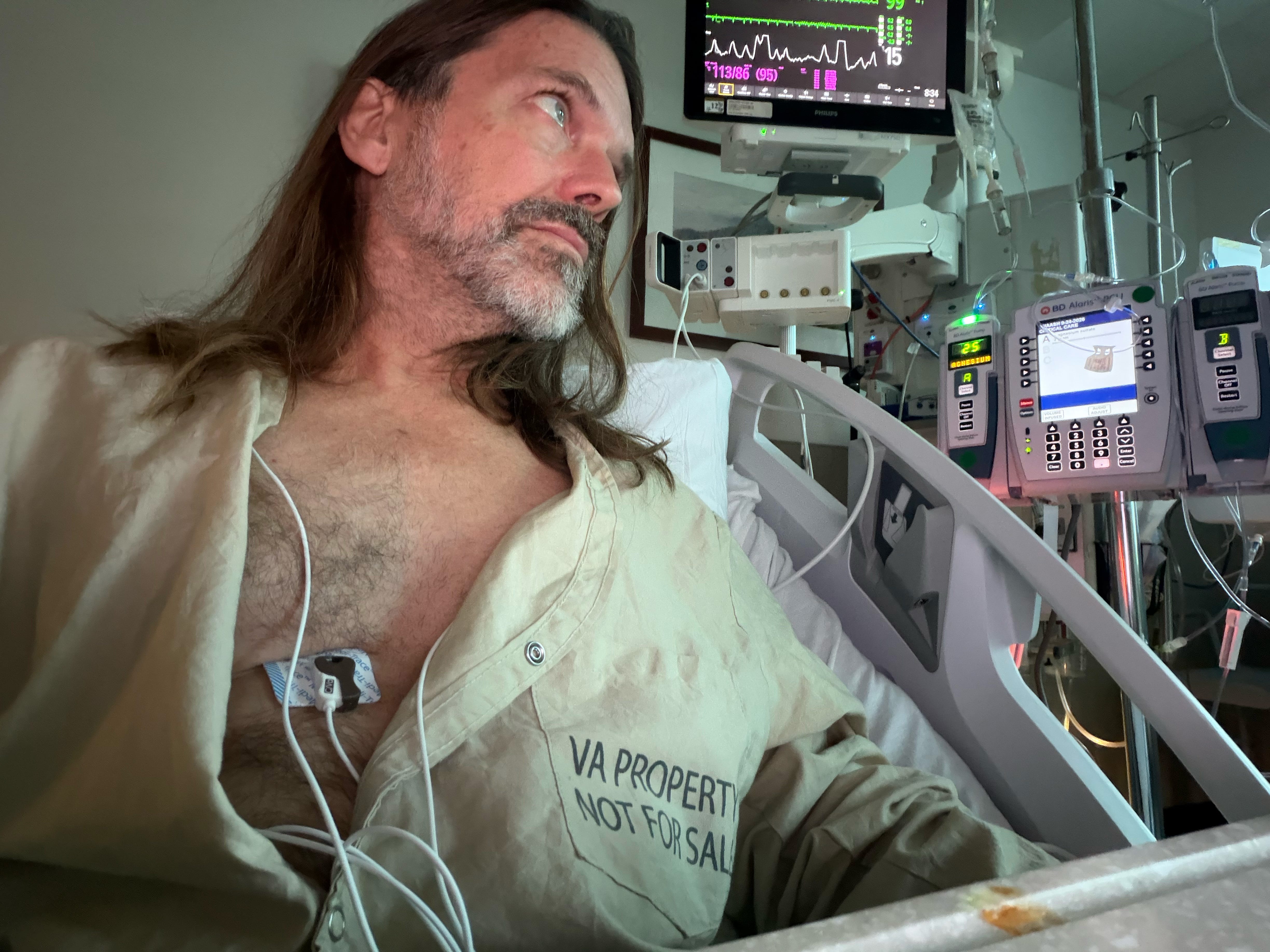
I’m writing this from a hospital bed. This is my second time in the hospital in the last ten days, due to an atrial flutter in my heart.
150. Beats. Per. Minute.
Before the first visit I had just returned from my friend Jason’s memorial in Massachusetts. We drove fifteen hours on Saturday to get there, spent Sunday remembering him, and then drove fifteen hours back to Asheville on Monday.
Jason was an addict. He rose up from the depths of sorrow in the end, took a few thousand breaths of fresh air, made a handful of meaningful amends. He was a complicated soul, but one whom I loved deeply.
Sometimes the damage is too much for the body even after recovery. His heart finally said, “Enough.” Blessings on your journey, my friend.
Recovery
I pride myself on having given up alcohol. As of Valentine’s Day 2026, I have been six years “California sober.” Alcohol is an insidious and ubiquitous drug, glorified and deadly. It has great branding, but leaves behind a trail of violence and gross behavior. I curse its existence, no matter how many microbreweries want to disagree.
For me, it kept me underwater, just below the surface, unable to achieve my potential. It took my spending money. On booze I was obnoxious in my flirtiness. I looked at each drink like a gateway to connection with women. Trying to find the courage to speak, without saying things I would regret. An impossible balance. Yearning for love, and then behaving in ways that kept love from finding me.
There are dozens of professional relationships I damaged with drinking, as well. No one wants a drunk photographer, even when autofocus can save the day.
Beyond alcohol, there are plenty of substances to explore. Marijuana use was a constant for me. It started in my teenage years. I oriented my whole life around being high. There weren’t dispensaries, so I would sit in my dealer’s apartment listening to Lynyrd Skynyrd and making small talk until I felt I had paid my socialization fee, then leave.
There is a ritualistic aspect to smoking weed. In my high school days we cleaned seeds out of browned pot leaves on the inside of double album covers. The weed in the early ’80s was called “Colombian Gold,” and it was full of seeds and stems. Propping one side of the cover up, we would use a credit card to separate the buds, letting the seeds roll down to the center.
When supplies ran low we would scrape our pipes to smoke the resin. Rolling joints, smoking bongs, hash under a glass; these were a few of my favorite things.
With legalization it became less fun. Everything was corporatized. What did I expect? This is America. After a while I didn’t want to smoke anymore, and switched to edibles.
Pot held me back, fogged my brain, wasted a lot of my time. It’s pretty tame compared to everything else, but not benevolent.
I was disciplined enough not to use it at work. I didn’t use saws and hammers when I was high. I didn’t do professional photo gigs or teach yoga high. Just weeknights and weekends. Enough to keep a consistent fog over the prairies of my mind.
Finally I gave that up, too. I have strong determination when I decide to do something. I’ve been vegan for thirty years. Off booze for six years. Now I’ve been off weed for nine months. I feel clearer, cleaner, and I don’t second-guess myself as often.
Addiction is a shapeshifter
The addict doesn’t go away when the drug of choice is removed. It just changes the object of addiction.
For Jason, the opioid addiction shifted to tobacco and ketamine. The rehab center he went to gave him ketamine treatment, and he found a new high. Between lines of K he smoked cigarettes, and it was hard to be around him because of both.
I preferred a gentler high. Shortly after we moved to Asheville I found kava lounges, bar-like spaces with no alcohol. It seemed the perfect place for a recovering drunk. I played the open mics and found a social scene that didn’t smell of spilled booze and lost dreams.
It was there that I found kratom, the psychoactive leaf from a tropical evergreen tree (Mitragyna speciosa) native to Southeast Asia. It acts as a stimulant in low doses and a sedative or opioid-like pain reliever in high doses.
The first few highs were really nice, a little euphoric and heart-opening. The kava lounges use actual leaf instead of the concentrates that are sold in gas stations. A softer buzz, a feeling of connection to the universe. I would play the open mics about once a week, floating above my fingers on the strings, and all was good.
Eventually I bought bags of the powder and started making smoothies with it. It would give me a little extra boost of energy at work. The downside was that when I was on kratom and wanted intimacy with my partner, Lisa, I couldn’t perform. Even though I felt more loving towards her, the mind-body connection was broken (I have experienced this with MDMA on a far grander scale).
What do addicts do? We arrange our lives around our bad habits. I tried to keep the natural rhythms of our sex life intact by doing kratom for a couple days and then taking a day off to make love. This was beneficial in that it kept me from getting so addicted that I would go through withdrawals. Not the best plan for harmony in a relationship, but it was an addict’s compromise.
My next step into dog shit came when some nicotine pouches were left at our house by a friend. Out of curiosity I tried one, and within a couple weeks I was buying my own and using them all day long. Compounding errors.
As Jason’s memorial came closer, my work life picked up speed. I was doing carpentry about thirty hours a week, and a bunch of photography gigs came in. To keep up, I started to buy kratom drinks at gas stations, which are made from concentrates and far stronger than the leaf-based drinks in the lounges. They are unregulated, and some have heavy metals and other contaminants. On my days off from kratom, I felt achy and aggravated and increased my coffee and nicotine consumption to compensate.
Coffee. Kratom. Nicotine. Repeat.
Somehow I convinced myself I could manage all this madness. There is a comfort in the chaos. My brain just wants to be altered.
Finally the time came to go remember Jason. I’d had a bad feeling about it ever since I got the invite. The timing was bad. I was tight on cash and way too busy to go, but he was my best friend. A bunch of other close friends were counting on me to be there. One last inconvenience to honor his friendship.
I drove up with a couple of mutual friends, taking turns driving the fifteen hours between Asheville and Leverett, MA. I enjoyed my coffee/kratom/nicotine combo all the way there.
The day of the ceremony it was raining, and I pitched in by moving a couple of large trees’ worth of firewood to the fire pit and helping keep the fire alive. At the ceremony I was the videographer. I played a song I wrote for Jason to honor him. Go, go, go.
After a couple more hours of socializing I went into the house and fell asleep. My closest friends were there playing music and catching up, but I was done. I had exhausted my body, and missed the sweetest part of the trip.
The next day we woke up and drove back to Asheville. Fifteen more hours of driving, more coffee, more nicotine, more kratom. We got back home at midnight and I crawled into bed with Lisa and our dog, Bodhi.
My journey into hospital visits and medical procedures
My thirty years of veganism have given me advantages when it comes to health. Low cholesterol, great poops, I stay slim, have lots of energy (even without kratom), and I get to eat the most amazing food. Truly.
I also pride myself on being unmedicated at fifty-nine. No row of pharmaceutical pill bottles on my dresser.
In the mid-2010s, I began having some episodes of atrial fibrillation as I lay down for bed at night. I went through a round of doctor visits and had my heart scanned and monitored. They found my heart itself was strong and healthy. One of the risks of AFib is that blood can coagulate and lead to stroke. My clean vegan blood was less likely to do this, and with the oversight of the doctors I opted out of taking blood thinners.
At the time, I was feeling a lot of stress at work. I was also drinking alcohol two or three times a week. Alcohol is a big factor in AFib. Once I dealt with the stress and cut back on drinking, the AFib went away on its own. Occasionally I would feel an irregular heartbeat, but for about ten years, nothing major.
Returning from Jason’s memorial, I was excited to get back to work. Tuesday morning I was back at my carpentry gig. I remember taking a couple of extra breaks during the day, feeling a little tired. I had a gas station kratom drink to keep me going.
When I got home at five I felt a pressure across my chest, like everything was sucking inward. It wasn’t painful; I could breathe OK. I thought to myself, “This is one of those things that happens to men and they don’t do anything about it, then die from a heart attack.”
When Lisa got home we walked Bodhi and I told her about it. We decided I should go to Mission Hospital in Asheville. I was getting cold chills. The Internet told me this was bad. She drove me to the ER, and when they hooked me up to the monitors my heartbeat was at 150 BPM. The Internet was right.
They kept me overnight. My heart was in atrial flutter, an arrhythmia where the heart rhythm is more organized and less chaotic than in AFib. But it beats fast. They ran some medicine through an IV to slow my heart down. The treatment for atrial flutter is a procedure called an electrical cardioversion. It’s a shock to the heart, a little gentler than the ones we see on TV.
To prepare, they shaved my chest, numbed my throat, and then put me under with anesthesia. The throat numbing is preparation for a procedure called a transesophageal echocardiogram (TEE), where an imaging technologist guides a transducer (a sonogram device in the shape of a thin, flexible tube) into the mouth and down the esophagus, using sound waves to obtain images of the heart. All this to make sure there are no blood clots that would break free during the cardioversion and get into my brain, causing a stroke.
With one electrode on my chest and one on my back, the doc gave a shock that briefly stopped and reset my heart rhythm. I woke up remembering none of this, feeling much better. They prescribed me some blood thinners and a heart-regulating drug and sent me home.
One of my fears was that thirty years of veganism might be the reason for my arrhythmias. Fortunately, it seems the opposite is true. AFib is caused largely by conditions like high blood pressure, obesity, diabetes, coronary artery disease, heart failure, and chronic inflammation. Plant-based diets improve most of those conditions.
Heavy drinking definitely raises AFib risk, roughly 8% more per daily drink in one analysis. Caffeine doesn’t appear to raise risk and might even be mildly protective. Fish findings are mixed. One large study found that eating dark fish more than four times a week was associated with higher AFib risk, possibly because of mercury. Take that, pescatarians! (Stats from National Library of Medicine)
What I did find out after talking to my parents is that the arrhythmias are probably hereditary. My father, now ninety-one, has been dealing with them for several years. So far they haven’t killed him.
One more time around
My primary care appointment at the VA was fortuitously scheduled one week after my hospital visit. I went in expecting to get assigned a cardiologist and explore the possibility of having a procedure called an ablation.
Catheter ablation is a procedure that uses radiofrequency energy (similar to microwave heat) to destroy a small area of heart tissue that is causing rapid and irregular heartbeats. Destroying this tissue helps restore your heart’s regular rhythm. Catheter ablation destroys the abnormal tissue without damaging the rest of the heart. ~ AHA
I felt a little twinge around my heart as I walked into the Asheville VA Medical Center. Lisa had already told me she felt my heart racing in the morning. The nurse started taking my vitals and frowned. My heart rate was back at 150.
My primary care doctor said I should go to the ER. Luckily, it was just down the hall. A nurse wheeled me to the ER and I went through the whole process again. IV drips with heart-slowing medicines. Nurses, doctors, and med students with all kinds of questions. Peanut butter and jelly sandwiches. Peeing in bottles. Hospital gowns. Sleeping with IV needles in both arms.
The VA cardiologist was in touch with my Mission Hospital cardiologist. They both agreed I should get the ablation, but it wouldn’t be until January. In the meantime I would get another cardioversion to reset my heart. To prevent the flutter from coming back, they put me on a new medicine, one with side effects that seem worse than the disease (the kind of side effects we hear in the sped-up narrations at the end of pharmaceutical commercials).
“It is only for three months,” the doctor said. “Most of those side effects take years to develop.”
Aftershock
One thing about being in a hospital: it gives me lots of time to write. I had the cardioversion this morning, and now it is dinnertime. They are going to let me go home soon.
These medical interventions are truly miraculous. I am not sure what would happen if my heart just kept fluttering at 150 BPM, but I imagine I would eventually die. Of course, I will eventually die of something. But here I am, for now. Not really out of the woods, but I can touch the trees and breathe the forest air, so I am happy.
I haven’t had kratom or nicotine pouches since my first hospital visit. It takes a good scare. Jason didn’t quit ketamine until it did so much damage that he couldn’t pee without extreme pain. One visit to the ER with atrial flutter was enough for me. Two sealed the deal.
Of course, I can’t say for sure it was the kratom or the nicotine. The thirty-hour round trip to Jason’s memorial, the grieving. The deluge of new photo shoot clients coming in suddenly. Stress, drugs, heredity. My time in the Marines, being poisoned by the water I drank and bathed in. All of the above. Or none.
The heart beats on an electrical system. That is why shocks can reset it. Viewing the last few months through my handyman worldview, it seems reasonable that my addictive behaviors were overriding the circuitry in my body. I’ve been running my HVAC on an iPhone charger.
Reflections
The last decade of my life has been very humbling. The years I could have spent building strong foundations for my future were instead spent chasing ghosts. I had an ego who told me I was someone that I’m not. Reality slowly eroded that vision as I lost friendships and connections I thought would be forever. I didn’t understand why some people stopped answering my messages.
The tools of yoga and Buddhism, the insights of psychedelics used respectfully, these have been of help. Without them I may have just spiraled out into oblivion. Still, with sixty approaching, I feel some regret. My childhood self just wanted to play music, and only now am I finally getting around to it.
I am grateful to be in recovery, to finally be taking life a little more seriously. I also feel like my body is fragile where it used to be strong. I am not happy to be taking meds. Another humbling.
I told a therapist friend of mine about my first hospital visit, and the journey I have been on. She said I might have ADHD. Lisa also mentioned the possibility. I don’t really know much about it. Another rabbit hole to go down.
I have been reluctant to tell this story. It certainly isn’t my whole story; I have done some amazing things, and I have plenty of friends still with me. Perhaps it is the story that my struggling heart needs to tell in this moment. Get it off my chest.
Last night I lay in bed wondering if I will see my sixtieth birthday. What if these are the last words that I write?
Last writes.
You’ve laid yourself bare, my friend. Humbled and courageous. We can know a person a long time and still be unaware of so much. I appreciate you opening up about your struggles, as well as your joys, and am so glad you have great support. Sending you lots of love 💟